
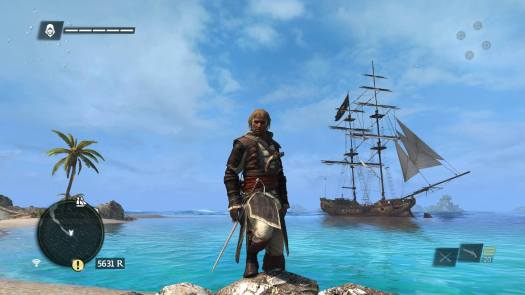
Developer/Publisher: Ubisoft Montreal/Ubisoft Released: October 2013
Played on: PS4 (also available on PS3, 360, Xbone, Wii U, PC)
After two middling titles in Revelations and AC3, the Assassin’s Creed series really needed to prove it was still one which could deliver a fun open-world adventure experience. In Black Flag, Ubisoft delivers exactly that in spades. This golden-age-of-piracy sandbox is the most untethered fun I’ve had in an Assassin’s Creed game since Brotherhood, and while it still fails to deliver a cohesive story, it is an epic experience and a real heave-ho for the floundering series.
Lets get the story stuff out of the way first, and it’s a mixed bag. You play as Edward Kenway, grandfather of AC3’s Connor and another ancestor of old mate Desmond. Thankfully Kenway is imbued with actual personality, unlike his grandson, and is a classic roguish character who is interested in the profiteering and freedom to be had from the pirate life. Edward has a reasonably formulaic character arc, but is accompanied by some notable historical figures including Blackbeard, Benjamin Hornigold, Anne Bonney and a handful of other distinguished pirates from the early 1700s. Black Flag strikes a good balance between historically accurate depictions of pirates and the misleading depictions found in pop-culture, “pirate talk” is limited and instead an attempt to showcase a range of British accents is on show. The plot is loosely tied together by a few historical events often centred around the “pirate republic” of Nassau, and while the characters are fun in small doses, the overall story doesn’t gel and is easily forgettable. Kenway’s transition from pirate to assassin is almost non-existent, and while this conceit benefits the freedom of the gameplay, it is to the detriment of any true story and character progression. Considering the quality of the open world gameplay, this is probably a concession worth making, but still immersion-breaking. You always feel like you’re playing a game, and Black Flag pretty much acknowledges that.
Kenway’s story is one you play from an Animus somewhere in Montreal. This game, like its predecessors, also involves a modern sci-fi component. You occasionally switch to a first-person view of an employee for Abstergo Entertainment, run by the evil Templars you’ve been combatting in previous games, and seemingly modeled on Ubisoft Montreal’s office. The entertainment division is a way to make money from plumbing Desmond’s DNA memory, creating interactive experiences for mass audiences to enjoy while delving into Assassin secrets. At first I found these sections totally refreshing, possibly due to the thrill of not being Desmond any longer, but it never really goes anywhere too interesting and serves mostly as a justification to continue the series pretence of experiencing the past through the animus device. Mostly these modern-day bits are fetch quests and simple hacking mini-games, and you can finish them quite quickly if you’re not interested in unlocking all the collectibles, but there are dozens of nice nods and references to the previous games and the way Abstergo is glorifying the Templar characters in each story.
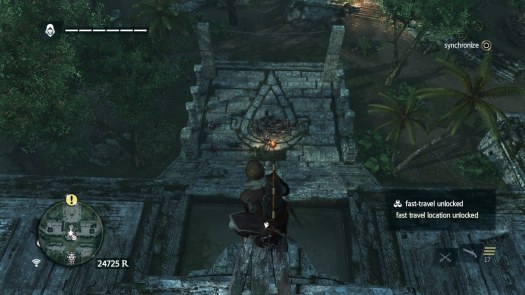
Where Black Flag shows its true potential is in its open world adventures across the Caribbean. For the landlubbers, there are a handful of towns to explore like Nassau, Kingston and Havana, as well as a bunch of islands and cave hideouts. While not exactly renaissance Italy, the cities are well designed for climbing and tree-top free-running. In an unprecedented move in the series, you no longer gain “notoriety” for illegal acts on land, meaning you don’t need to move stealthily through the towns avoiding authorities after you’ve been naughty. This is a surprisingly liberating move, the notoriety level in previous games started feeling like a burden, and its abandonment here allows for a much more pleasant exploration of each location. If you miss the thrill of sneaking past guards, never fear, there is plenty of that in the game through a more binary system of notoriety, in many areas you are simply trespassing and will be attacked. But if you’re like me and gain a strange satisfaction from simply climbing viewpoints to ascertain the locations of treasure chests and mini-quests in the area, then seek them out for hours and hours on end, then Black Flag will tickle that particular obsessive compulsion. I’d spend hours either listening to music and podcasts or remote playing on the Vita with the TV on and just collecting everything I possibly could before returning to main plot.
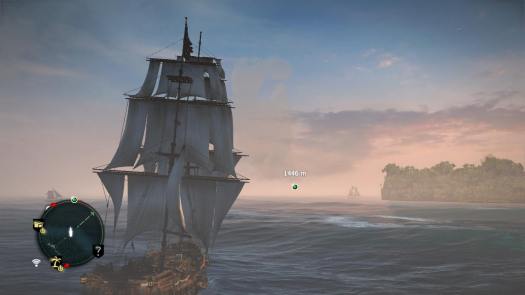
Then there is the sea-based adventures of Captain Edward Kenway and his trusty boat ship, the Jackdaw. The most impressive parts of Assassin’s Creed III were the sea travels and battles, and this has become one of the most significant parts of Black Flag’s makeup. After all, what would a pirate game be without a pirate ship! The Jackdaw sails the Caribbean, drifting across a beautifully rendered ocean. Ship-to-ship combat is nuanced and challenging, with the inclusion of indispensable long-range mortars and four “legendary ships” which are optional battles to truly test your skills as a Captain, but make sure you’ve upgraded your ship first! You’ll spend many hours attacking Spanish and English vessels to loot their cargo holds for valuable money (reales) and essential items like wood, metal and cloth that are required to upgrade the Jackdaw. This never quite gets tiresome, as you can always just go back to land when you’re sick of it, and the combat cycle is extremely satisfying. After crippling a ship, you can either sink it and salvage a portion of their loot, or board and conquer the ship to maximize your earnings. The transition between ship-to-ship combat to letting go of the wheel and boarding the enemy’s ship via a swinging rope is one seamless movement, and you’ll want to use your arsenal of pistols and smoke bombs as well as your trusty blades to capture some of the more well defended ships.
Interestingly, the “notoriety” system that was removed from the land-based locations has been implemented on sea! Sink too many ships without bribing an official or sparing the lives of some grateful ship captains, and you’ll soon have Hunter ships out to claim the bounty on your head. There are occasions where you’ll need to be stealthy on the sea, staying out of a ship’s visual range, which is absurdly only directly ahead and to the left and right of the ship. Weird that nobody on the Spanish Man O’ War would notice the huge pirate ship sailing right behind them with a full crew singing sea shanties.
OH! THE SEA SHANTIES! A wonderful added detail is the over 30 unique sea shanties you can collect in the game and have your crew sing as you sail the seas. Sure, most of these chants are from an era WAY later than the period the game is set, but the songs are so perfectly performed and arranged they will get stuck in your head for days. Plus, its a videogame within a videogame, so all the historically inaccurate details and illogical bits are doubly forgivable, right? Like how you can do assassin missions from the start of the game, before you’ve even become an assassin. Or how if you dress Kenway up in an outfit without a hood, he still pulls an invisible one over his head in cutscenes. All ills are forgivable, its a glitch in the animus!!!
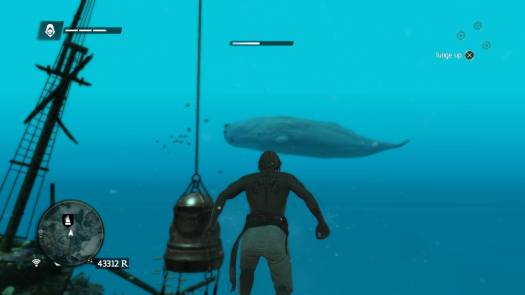
Aside from exploration and combat, the Jackdaw can stop to allow you to hunt sharks and whales for useful upgrades, attack forts to claim as your own, and use a deep-sea diving bell to allow Kenway to explore shipwrecks for loot at the bottom of the ocean. Seriously, there are a shitload of fun things you can do in this game! The variety of weather and environmental effects add a whole extra dimension to the game, as treacherous weather can be the difference between an easy sea battle and an absolute survival nightmare.
The game’s main quest, while not revolutionary, is a good iteration on the things the series has done right so far. Far better paced than Assassin’s Creed III, and well checkpointed to avoid unnecessary frustration. You’re still doing the same old things like eavesdropping on conversations and assassinating chumps, but with the added variety of sea-missions in a lovely-looking world you won’t mind revisiting all these Assassin’s Creed tropes. Some things are still broken, like the lazy and occasionally frustrating parkour system, but Kenway actually feels quite heavy, and the occasional clumsiness of the game’s controls almost feels appropriate. If I ate and drank as much Kenway seems to, I’d probably be jumping impotently beside a rock face trying to climb it too. Also, I’m not sure if the occasionally unresponsive combat is due to the poor controls in crowded situations or Kenway’s grog-filled belly impeding his reaction times. Yes, I’m forgiving a bunch of small annoyances because the game is so epic and a treat to revel in for well over 40 hours.
Verdict: Possibly the most ambitious Assassin’s Creed in terms of scope and gameplay variety, and it succeeds in being an addictive and fulfilling open world game, certainly the best pirating sandbox ever made. Some truly epic emergent gemeplay to be had on the open seas. Lapses in logic and story are forgivable, but I really wish a quality writer could bring some cohesion and character empathy to the series.
Should Bradley play this: Oh yes, he’d have a ball. You DO NOT need to have played the previous games in the series to enjoy this. Previous experience certainly helps you understand the meta-narrative and the core mechanics, but this is great as a stand-alone game.
 Elias Rambles