
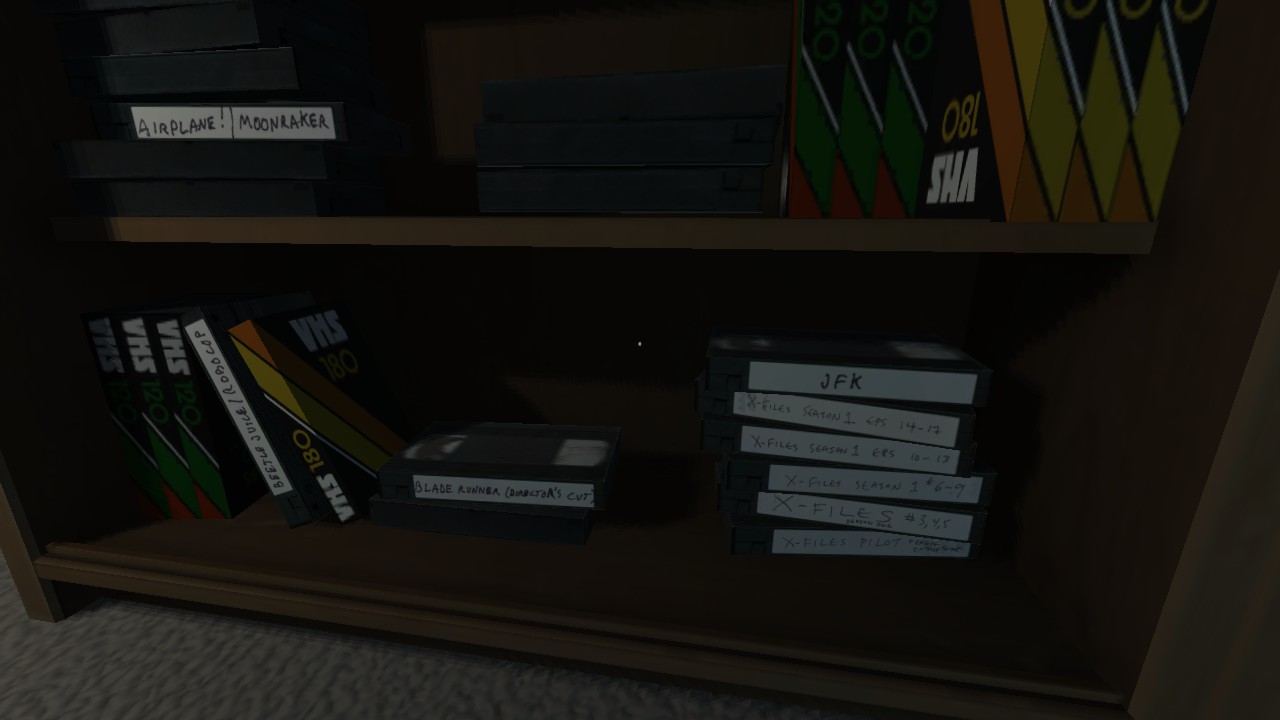
Gone Home’s 1995 period details are spot on
Developer: The Fullbright Company Released: August 2013
Played on: Mac (also available on PC, Linux)
Kaitlin Briar arrives at her new family home in 1995 after a year abroad. Her parents and younger sister aren’t home, and as she explores the dark and eerie mansion she realises something is amiss. Armed with only her Poltergust Vacuum Cleaner, Kaitlin must capture each room’s ghosts to free her family from the big Boo in the attic. Wait – scratch that last bit, I was playing Luigi’s Mansion around the same time and got confused.
Gone Home starts with the feel of a first-person horror game as you explore the deserted, poorly lit house. This tension is felt throughout the game and keeps you questioning what is going on, but there is ultimately never really any risk to your character. There is no combat or platforming, your sole purpose in the game is to explore the house and uncover what has happened to your family. You search through bedroom drawers, dusty cupboards, secret compartments and discover objects, letters and journal entries that slowly reveal the details of your family’s lives in the year you’ve been away.
The central story is Lonnie’s, Kaitlin’s teenage sister, and we are treated to her well-performed voiceover from time to time reading letters she wrote to Kaitlin as we discover relevant objects. The clues scattered throughout the house are perfectly placed and paced, allowing the story to unfold with the right level of intrigue and mystery while giving believable depth to the characters. Rummaging through their belongings makes you totally familiar with Kaitlin’s family and hits you with real empathy as new truths are discovered.
Like any good exploration game, it’s all in the details. The simulation of a 1995 household is spot-on and I delighted in discovering familiar VHS collections, scrawled Street Fighter moves, mix tapes, and Magic-Eye images that I was great at when I was 13 but suck at now. Setting the game in the mid-90’s also makes the conceit of uncovering story through letters and written correspondence totally believable. I can’t help but feel that a Gone Home set in 2013 would have involved logging into Mum, Dad & Lonnie’s computers, reading their emails and searching through their browser history, then game over. Not nearly as compelling as exploring a space and discovering discarded notes and hidden letters.
I’ve left story details intentionally vague – this is a game you should experience knowing as little as possible. The stories you will uncover are sweet, sad and sometimes disturbing, and you are unlikely to have put all the clues together before you make a run for the final room and one of my favourite video game endings of all time.
You can discover the whole game in around 2.5 hours which is a bit short, but Gone Home is something special that I hope to revisit again knowing what I know now. Ah, I see they added a developer commentary in October. Will have to reinstall and check it out!
Verdict: By focusing solely on an exploratory experience, Gone Home reveals the strength and potential of quality storytelling inherent in the videogame vocabulary. Perfectly designed and constructed, one of the most moving and memorable videogame experiences I’ve had.
Should Bradley play this: Absolutely. Whether $20 is worthwhile for a 2.5 hour game is debatable, maybe add it to your Steam wishlist and wait for the inevitable price drop, but it is unquestionably worth your time.
 Elias Rambles