

Developer/Publisher: Bethesda Released: November 2011
Played on: PS3 (Also available on 360 & PC)
Skyrim’s predecessor, Oblivion, was one of the first games I played on a modern console and introduced me to the concept of an open-world first person game. Sure, since then I’ve played games that played better, looked better, told their stories better, didn’t feature impossibly powerful mudcrabs, but Oblivion remained a hugely significant game for me. Leaving the sewers for the first time after learning the game basics and emerging into a huge, gorgeous open world that I could explore at my own whim was a defining moment in gaming. I remember walking forward, not sure where to go, stumbling across some ruins, going in to explore, and getting my arse kicked by a bunch of bandits. I was horrified and delighted at the same time – the game hadn’t given me any rules to follow, I could do whatever I wanted, the risk was all mine. I lost a lot of hours in the game.
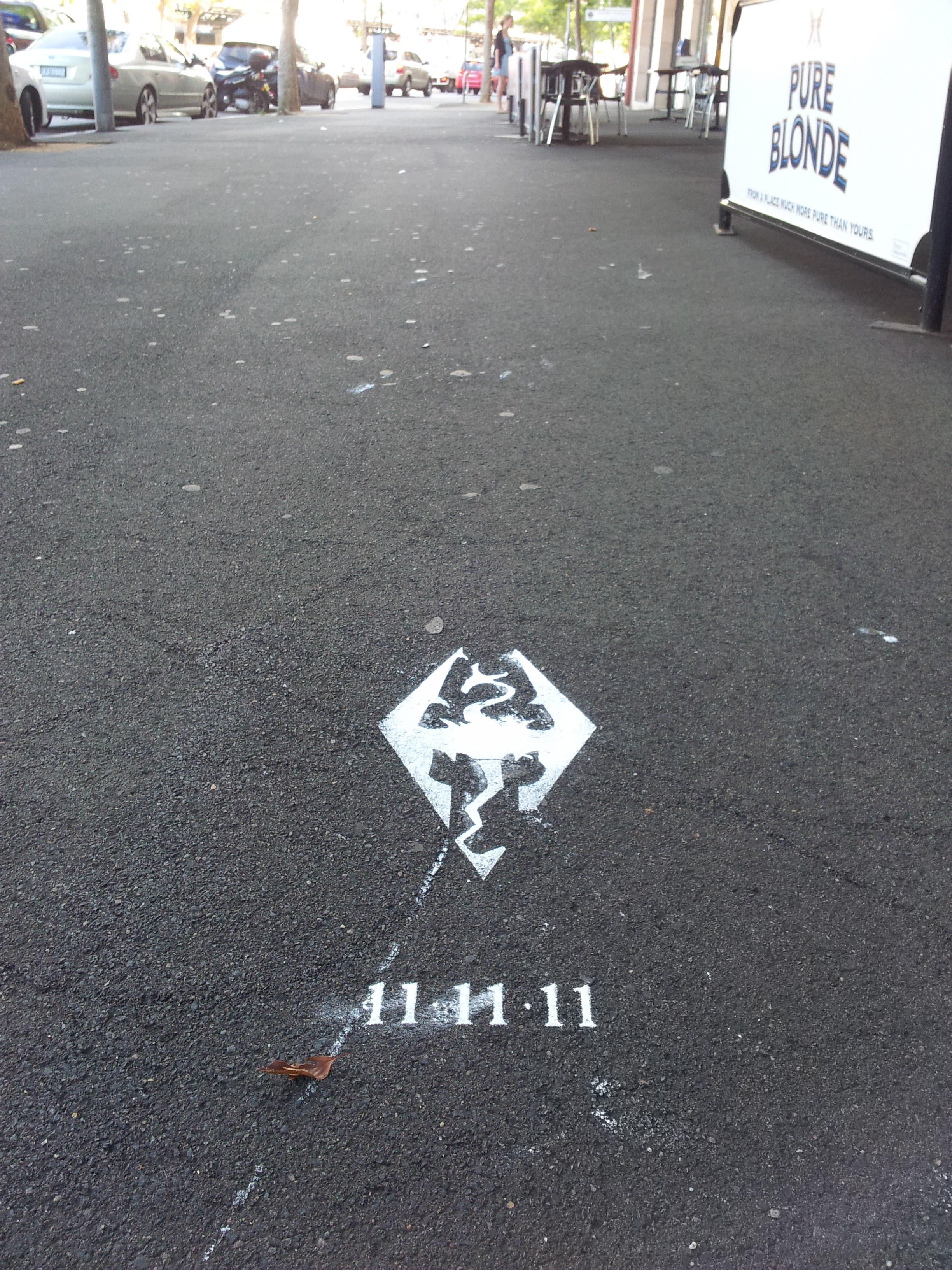
Skyrim stencil graf marketing near our old office in Surry Hills
So when Skyrim came out in late 2011, I was excited as hell, but had no idea when I would find time to play it. Most of 2012 I was too scared to start it, worried it would consume my life and that either my job or relationship would suffer grievously as I chose to slay dragons rather than do work or communicate with other human beings. So when I found myself with a bunch of leave in January 2013, I installed Skyrim on my PS3 (probably a good thing I waited so long, most of the PS3 bugs were fixed by then). In an intense few weeks, I sunk 130 hours into the game.
Skyrim totally lived up to my expectations. The world was vast and intricately designed. You could explore for hours and not see the same landscape repeated. From the snow covered mountains to hidden caverns filled with lush greenery, bustling towns and villages to atrophied ancient ruins, the game’s design is exemplary. Take the time to stop and look at the night sky and you’ll be treated to an ocean of dancing lights. Then look down just as a witch emerges from the trees and fires magic shit right in your face.
I emphasise the world because its probably my favourite thing in the game, I love exploring it, I love it as a setting for the dozens of quests you’ll undertake within it. In lots of ways its the strongest character in the game. But of course quests and loot and combat and cumbersome inventory management and all those RPG elements are the core of the game. The main questline is good, and you could happily play it and ignore the other quests and get a basic sense of Skyrim. The guild quests and side quests can vary from delightful to dull, which makes the spectacular world setting even more important. If I wrote about all the different quests and little adventures I went on I’d be here until next week, but they were certainly compelling enough for me to want to keep completing them.
Importantly, quests are open for you to do in whatever order you please, whenever you please, so if you decide to take a detour during a quest and visit a village to see whats going down, you aren’t punished, you’ll probably end up picking up a few extra quests or causing a little open world chaos.
I like to play a “good” character most of the time, so I still feel bad that I inadvertently led some giant spiders into a village and the millman died defending himself. Lots of emergent tales develop as you interact with characters and the environment, and the cumulative experience of those can be projected onto your character, who is essentially a blank slate. We internalise these experiences and our avatars narrative becomes one predominantly built in our own memories. Skyrim succeeds here, making it feel like the player’s experience is distinctly their own, built from the decisions they made at any point in the journey.
The game features some relatable and enjoyable characters, but in general the writing is not particularly strong, lacking some of the more memorable distinctiveness of characters that we met in New Vegas. It was never anything that bothered me too much, and the nature of such an open world with multiple possibilities means that investing too much writing time into particular characters would not have been fruitful. Its still fun to meet all the different characters in the world and get involved in their little day to day quibbles if you so wish. The world feels fleshed out, and while the lore and mythology doesn’t always feel particularly compelling, there certainly seems to be a lot of it.
How I Played
There is a certain level of replayability inherent in Skyrim’s character and play-style options. You can choose to be of different races, have different skills (warrior, thief, mage, etc), pretty standard RPG-fare, but enough to make me want to come back and play again.
From memory I chose a warrior class, native to the lands of Skyrim, which I assume would change how particular characters in the game treated me. I usually prefered to bash my way through things with shield and sword, but later used sword and magic as my primary tools, switching between healing and fire magic skills, not really leveling anything else up.
I was quite methodical in my approach the game, deciding early one that I would only focus on one mission at a time, that side-quests took priority over main quests (just to prolong the main quest’s end), and that if I stumbled on a quest while on another, I would return to it, but complete the quest I was currently tasked with. This felt like a good way to experience the world adequately without feeling to overwhelmed with quests. Of course this was also quite an obsessive approach, as I categorically proceeded through each mission one by one until my quest list was empty.
Concerned for my moral standing, I played through the Mage & Companion missions before finishing the main quest, and the Thieves Guild and Dark Brotherhood after it. In the end it turns out these make no real difference to your moral standing except that insignificant characters might have a different line of dialogue for you, condemning or fearing you.
I had houses in all the towns which I expanded to their fullest extent while stashing them full of loot from my travels, and a wife that cooked me steak and gave me money from her fruit stall. Life in Skyrim was pretty good.
Civil War
One of the most interesting additions to Skyrim is the Civil War taking place within its borders between the Imperial Legion and the Stormcloaks, which feels heavily inspired by the conflicts in Fallout: New Vegas. While the Stormcloaks could be accused of being barbaric nationalists who would rather see outsiders dead than on their home soil, the Imperial Legion promises peaceful unity amongst all citizens of Tamriel while limiting religious and cultural freedoms to appease foreign forces.
This part of the game was nicely setup with enough moral ambiguity that choosing either side could be seen as justifiable. In the end I chose to side with the Imperials as they seemed less likely to go about murdering everyone, however I decided that I would never assist in the persecutions of people worshipping forbidden gods. This decision is one that is more internalised, the game does not recognise that I’ve made a complex moral decision, it only acknowledges that I sided with the Imperials but failed some other unrelated quest. The blank slate nature of your character makes the flexibility here possible – you know what you are and you internalise that – but at the same time it feels slightly disappointing that the game can’t capitalise on this more. Not a real problem though, the player projecting their own intent, motivations and history onto their character as they play them seems to be the point of the way its designed, and encourages the use of our own imaginations, as few modern games do.
Music
Jeremy Soule’s soundtrack is awesome. I’m listening to it right now. Whenever I’d feel unmotivated in the early months of 2013, I’d put on the opening theme real loud at home or in the car and get pumped to climb mountains, slay dragons and avoid arrows to the knee.
Here is the theme music for 10 hours so you can stay super inspired all day at work:
And here is Tay Zonday’s cover, cause he did it:
DLC
Dawnguard introduced vampires. You could be a vampire if you chose to be. I didn’t want to be a vampire. It was alright.
Dragonborn, on the otherhand, was a great addition to the game. It opens up a whole new island that apparently featured in one of the earlier Elder Scrolls installments. And you get to ride a dragon. Yep. Its pretty cool.
Playing on PS3
There was a lot of noise about how the PS3 version of Skyrim was broken. Thankfully I didn’t experience this, it must have been properly patched by the time I played it. While the game ran poorly if my USB headphones were in use, it was otherwise quite reliable, only crashing once or twice in my entire 130 hours with it.
Loading screens, on the hand, are a different matter. Oblivion had slow loading screens, but Skyrim takes it to the next level. It was completely fine for the first 30 or so hours, but the more I did in Skyrim, the larger the save files became, and the slower the loading times became. In the last 30 or 40 hours of the game, I’d learnt to have reading material handy while I waited the few minutes it might take me to enter a new area. When you’re in the open world, you don’t experience the load screens, but at any point you want to enter a house or dungeon, get your book out.
If I ever replay it, which I hope I do, it’ll definitely be the PC version.
Verdict: While Skyrim is not close to being my favourite game of all time, if I was stuck on a desert island which somehow has electricity, a PC and one game, I’d want that game to be Skyrim. The world is large enough, the permutations varied enough, that I feel I could easily sink another lifetime of hours into the game. And I haven’t even touched what the gamemod community is doing with the game!
Should Bradley play this: Yes. Its awesome.
 Elias Rambles
The Witcher 2: Assassins of Kings – Geralt didn’t do it! – Elias Rambles